STCKY Resource Hub
Identifying and Controlling the Stuff That Can Kill You
Every serious injury or fatality can be traced to energy. STCKY is Ames' framework for identifying, controlling, and talking about the types of energy that can seriously harm you or your crew.
Use these resources to quickly reference exposures, talk through controls, and make safer decisions before work begins.
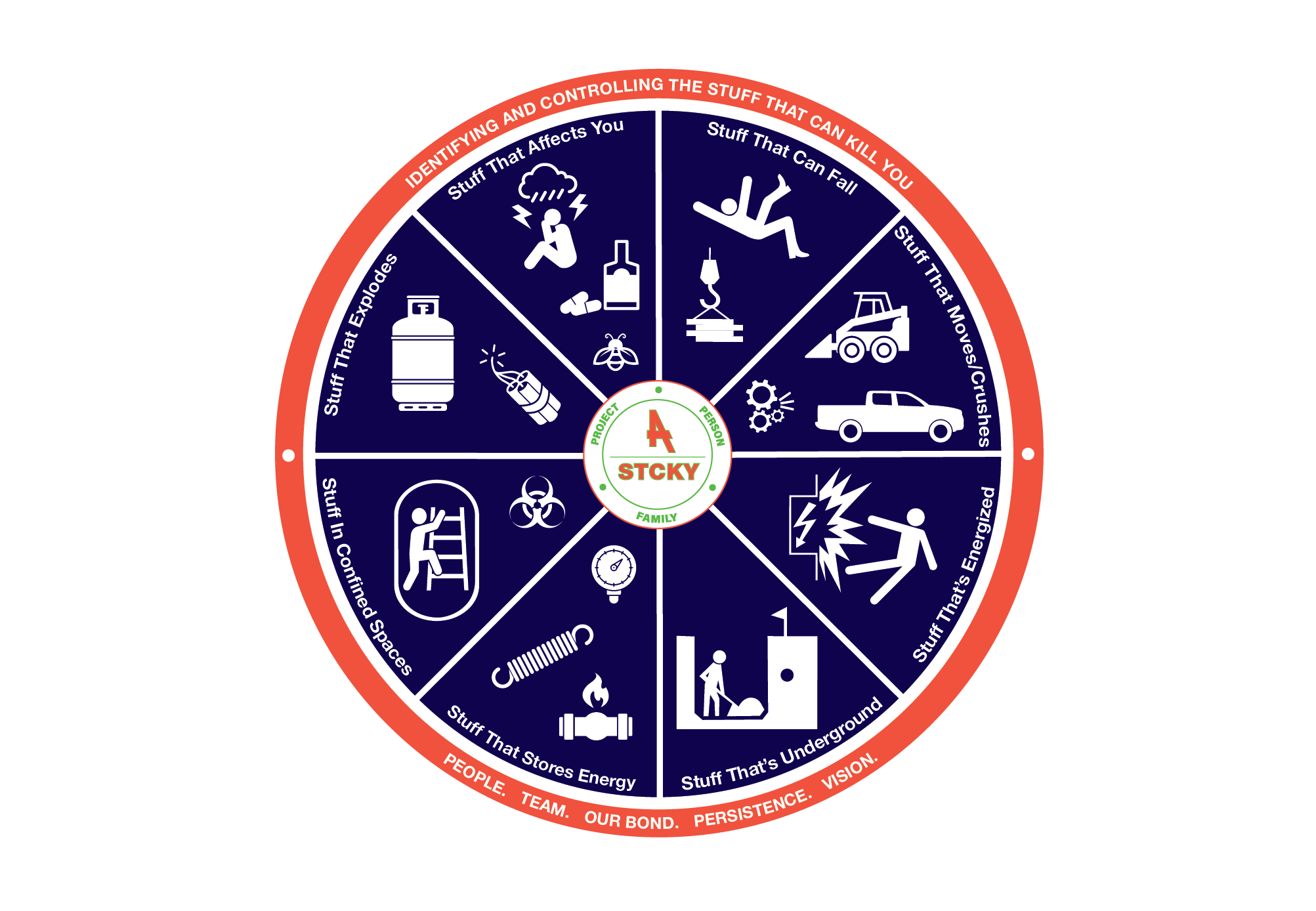
Preventing Serious Injuries and Fatalities with the Energy Wheel
The STCKY Wheel helps us recognize the most common high-risk exposures on our projects. These are not abstract hazards; they're the conditions and situations that show up every day in planning, huddles, and execution.
Additional Controls & Safeguards
1. Verify worker fitness for duty, including mental health readiness: no impairment, unmanaged stress, fatigue, distraction, or inability to focus.
2. Assess environmental conditions and implement required controls: heat/cold stress plans, hydration, work-rest cycles, shade/warming, and acclimatization.
3. Identify wildlife, insects, and hazardous vegetation and apply controls: repellents, awareness briefings, restricted zones, and removal when required.
4. Confirm medical and first-aid readiness: trained personnel on-site, stocked kit, accessible emergency response plan, and clear treatment routes.
5. Follow the Ames, client, and project severe weather protocols: lightning radius, high-wind shutdown criteria, shelter locations, and communication steps.
6. Document all environmental and personal risk factors and immediately brief the crew when conditions or readiness change.
7. Use Ames’ employee assistance program, Lyra.
1. Confirm compliance with fall protection requirements: full-body harness, SRL/lanyard, proper fit, and inspection log.
2. Verify that anchorage points meet 5,000-pound rating or engineered equivalent and are positioned to minimize fall distance.
3. Ensure scaffolds are fully decked, railed, based, tagged, and inspected daily by a competent person.
4. Proper ladder setup: 4:1 angle, 3-foot extension, tied off, defect free, and positioned on stable ground.
5. Establish hard barricades and enforce no work under suspended loads, maintain overhead exclusion zones, and include signage.
6. Review the rescue plan, stage retrieval equipment, and ensure workers are trained.
1. Complete and document pre- and post-shift equipment inspections.
2. Enforce spotter protocol: clear hand/radio signals and eye contact before any equipment movement.
3. Maintain exclusion zones and control travel paths with proper delineation.
4. Follow traffic control plans: posted speeds, right-of-way, lighting requirements, and berms at mid axle height.
5. Verify load securement meets DOT standards: correct chain grade, tie-down count, binders, and no damaged rigging.
6. Keep equipment at safe distances from edges of excavations.
1. Follow LOTOTO policy.
2. Maintain minimum approach distances to overhead lines per voltage charts; use spotters.
3. Use GFCIs on all 120V tools; remove damaged cords (cuts, exposed wires, missing ground prongs) from service.
4. Confirm temporary power is grounded, bonded, covered, and free of exposed wiring or open panels.
5. Wear arc-rated PPE when within NFPA 70E boundaries; no unauthorized energized troubleshooting.
1. Ensure that dig permit has been properly filled out.
2. Verify utility locates; pothole to expose actual depth and location; install supports or shielding where required.
3. Determine soil type and slope accordingly:
• Type A = ¾:1 (53°)
• Type B = 1:1 (45°)
• Type C = 1½:1 (34°)
Document method (sloping, shoring, shielding) in the JSA and accompanying permit.
4. Install trench boxes, hydraulic shoring, or shields when slopes cannot be achieved; ensure protection extends above the trench edge.
5. Maintain a 2-foot setback for all spoils, materials, and equipment.
6. Provide an approved means of egress within 25 feet of employees who enter the trench (ladder, stairway, or ramp).
7. Stop work immediately if conditions change.
1. Perform LOTOTO on hydraulic, pneumatic, mechanical, chemical, and gravitational energy sources; verify zero-energy state.
2. Identify pinch and crush points; install or confirm guards and barriers—never bypass or modify them.
3. Inspect all tensioned systems: chains, binders, cables, springs; remove any deformed or worn items.
4. Use appropriate cribbing/blocking; no rocks, scrap lumber, or makeshift supports.
5. Secure all transported loads per DOT requirements: correct tie-down count, working load limits, angles, and edge protection.
6. Pipes transported/delivered via truck must be secured prior to loading/unloading and exclusion zone established.
1. Determine if the space is permit-required; complete permit including hazards, controls, rescue plan, isolation steps, and monitoring.
2. Conduct initial and continuous atmospheric testing with a calibrated meter; do not enter until readings are safe.
3. Isolate all energy sources in the space via LOTOTO: electrical, hydraulic, pneumatic, mechanical, chemical.
4. Install retrieval systems (tripod/winch) and confirm rescue personnel, equipment capability, and communication readiness.
5. Assign a dedicated attendant with no other duties; maintain constant radio or verbal communication with entrants.
6. Barricade the entry, monitor for changing conditions, and evacuate immediately if conditions change.
7. All confined space workers must have proper training.
1. Identify flammable/combustible materials; remove ignition sources and equipment from the area.
2. Store compressed gas cylinders upright, secured, capped, segregated by type, and away from heat sources.
3. Follow hot-work permit requirements: fire watch, barriers, monitoring, and proper fire extinguishers.
4. Enforce blasting exclusion zones, signage, and radio protocols; follow misfire management procedures.
5. Inspect all welding/cutting equipment (hoses, regulators, valves) and remove defective equipment immediately.
6. Handle and dispose of aerosols properly.
Field Guides
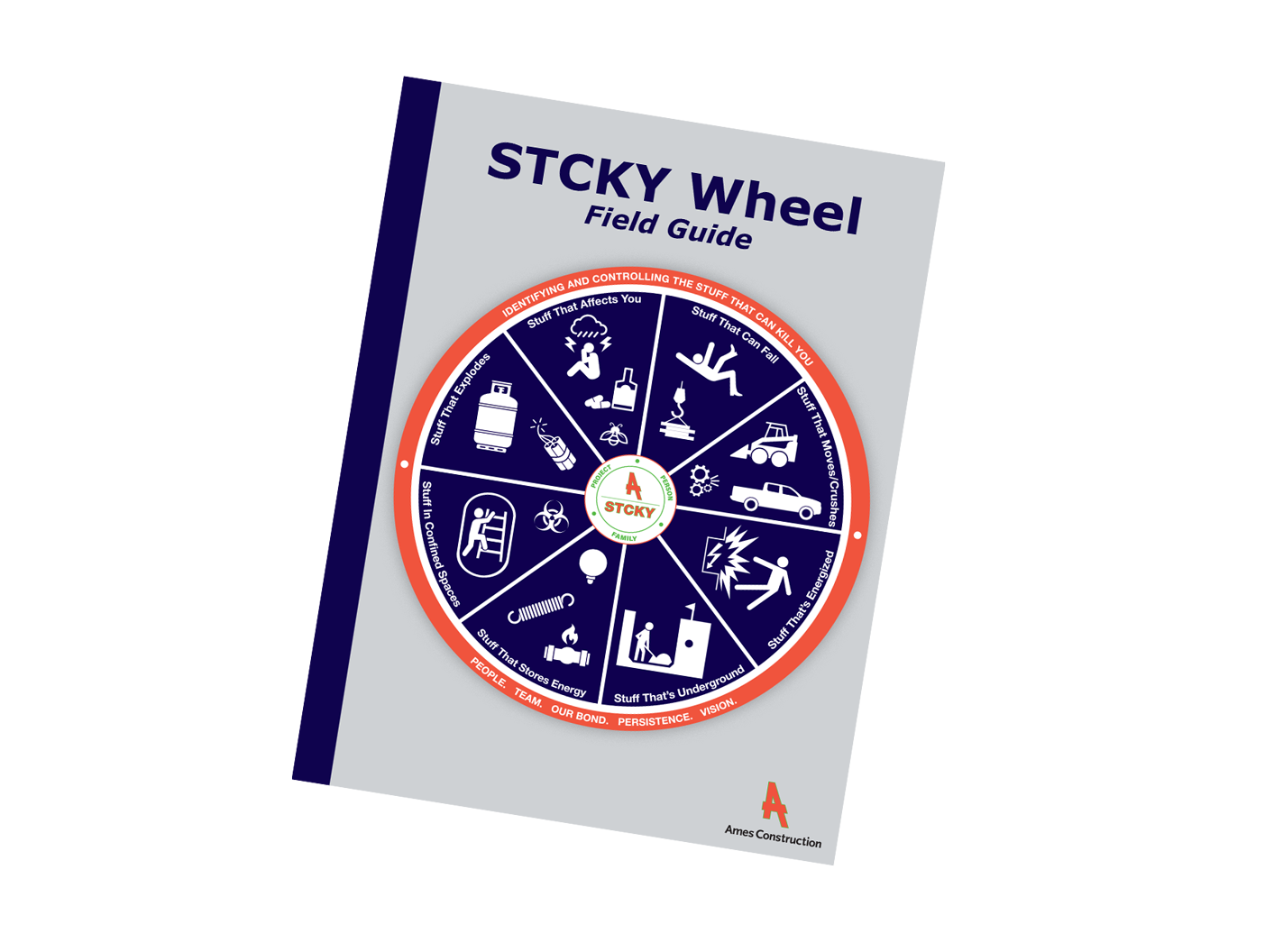
Use the STCKY Wheel Field Guild during planning, pre-task discussions, and huddles to reinforce expectations and align the crew.
STCKY Wheel Field Guide (English)
STCKY Wheel Field Guide (Spanish)